Astrocartography Map: How Location Affects Your Astrology
Astrocartography maps show where your planetary lines fall—so you can choose cities that fit your career, love life, or next move. See what Sun, Moon, Venus, Saturn, and other lines mean for relocating, travel, and everyday life. Try AIFATE's free astrocartography map generator to see your own lines.

Astrocartography map is a location astrology technique that projects your birth chart onto a world map to show where your planetary energies become more visible. It can relate to real choices such as career moves, love, family life, timing, travel, and the feeling of belonging in a place. This article explains how the map works, what the main planetary lines mean, and how to use AIFATE tools to compare locations with more clarity.
What Is Astrocartography and Location Astrology?
Astrocartography is a branch of astrology that connects your natal chart with geography. Instead of reading your planets only as signs and houses, it shows where those planets were rising, setting, culminating, or reaching the bottom of the sky at the moment you were born.
The practical question behind location astrology is simple: does a place bring out a certain part of your chart? A city near your Sun line may highlight visibility, identity, and leadership. A city near your Moon line may feel emotionally familiar, but it can also make family matters and moods harder to ignore.
In chart work, I often see people use astrocartography after a life shift: a remote job offer, a breakup, a university choice, a visa window, or a desire to leave a city that no longer fits. The map does not choose for you. It gives you a symbolic weather report for how different places may activate different parts of your nature.
- For living: look for lines that support your daily life, work rhythm, relationships, and emotional steadiness.
- For moving: compare planetary themes with your actual goals, budget, visa rules, and support network.
- For travel: use the map to understand why some places feel romantic, inspiring, tiring, intense, or productive.
- For self-knowledge: compare your location lines with your natal chart so the map does not become isolated from the whole chart.
Astrocartography meaning becomes more useful when it is grounded in your full birth data. Your birth date, exact birth time, and birthplace create the foundation. If your birth time is off by even 15 to 30 minutes, some angular lines can shift enough to change interpretation near a city.
A good reading also respects reality. A Jupiter line can correlate with opportunity, but it cannot replace a work permit, language skills, or housing research. A Saturn line can feel demanding, yet it may be excellent for long-term training, professional discipline, or building a stable life after years of drifting.
How Astrocartography Maps Work: From Birth Chart to World Map
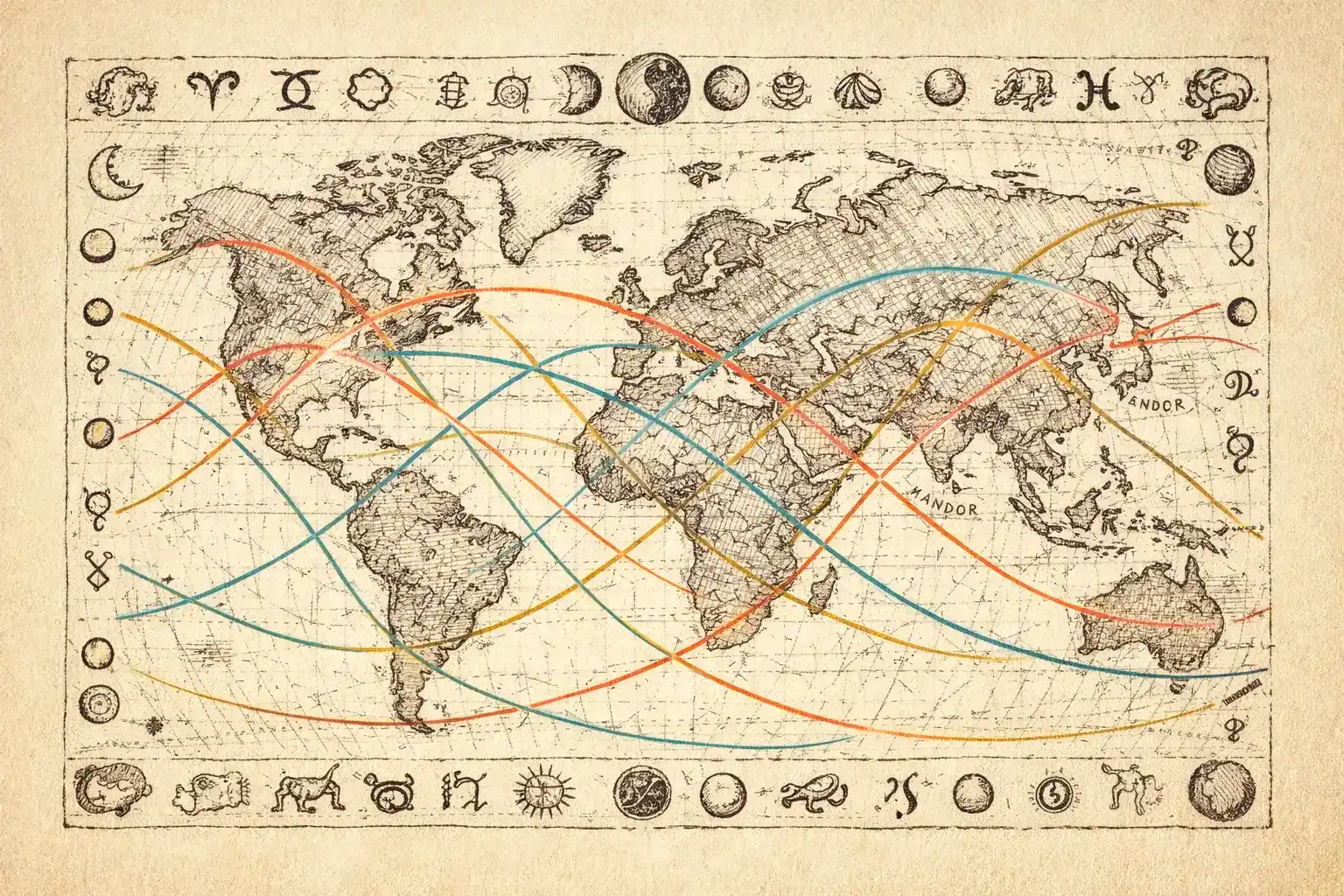
An astrocartography map works by calculating where each planet in your birth chart was on one of the four main angles across the globe. Those four angles are AC, DC, MC, and IC, and they describe how a planet expresses through identity, relationships, public life, or private roots.
In a standard natal chart, the angles are tied to one birthplace. In astrocartography, the same birth moment is projected onto Earth. The map asks: where in the world was Venus rising when you were born? Where was Mars on the Midheaven? Where was Saturn setting? The answers appear as lines across countries, oceans, and regions.
Generate your personal astrocartography map with AIFATE's free astrocartography map generator to see these lines based on your own birth data. It is usually best to start with your full natal chart first, so you know whether a planet is easy, challenging, or mixed in your chart. You can check that foundation with AIFATE's free birth chart calculator before judging any location line.
What Do the Colored Lines Represent?
The colored lines represent planets placed on angles. A Sun-AC line is not the same as a Sun-MC line, even though both involve the Sun. The planet describes the theme; the angle describes the life area where that theme becomes more visible.
- AC or Ascendant line: how you present yourself, start fresh, and experience your body and identity.
- DC or Descendant line: partnerships, clients, collaborators, dating patterns, and open conflict.
- MC or Midheaven line: career, reputation, ambition, public role, and long-term direction.
- IC or Imum Coeli line: home, family, ancestry, privacy, emotional roots, and inner security.
Distance matters. Many astrologers use a rough range of 200 to 300 kilometers, or about 125 to 185 miles, from a line as a zone where the symbolism may be felt. The closer you are to the exact line, the more pronounced the planetary signature can become, though the strength also depends on your natal chart.
Line crossings and nearby clusters deserve extra attention. A Venus line near a Jupiter line can feel socially and creatively supportive, while a Mars line close to a Saturn line may bring pressure, stamina, frustration, and hard-earned results. Use the map as a filter, then check the relocated chart, transits, and real-world fit before making a major move.
For a practical next step, Try AIFATE's astrocartography calculator to explore your planetary lines, then list three cities you are considering. Compare the planet, angle, distance from the line, and your reason for going there. A map becomes far more helpful when each place is tied to a clear question.
Planetary Lines Explained: Sun to Saturn (and Beyond)
Planetary lines in astrocartography show which parts of your natal chart may become louder in a location. A planet does not become "good" or "bad" simply because you move closer to its line; it becomes more active, more visible, and often harder to ignore.
The table below gives a practical overview of planetary lines meaning for living, moving, and travel. Read it together with the angle. For example, Venus-MC may support public charm and creative reputation, while Venus-IC may feel better for nesting, decorating a home, or softening family dynamics.
| Planetary line | Main themes | Best uses | Watch for |
|---|---|---|---|
| Sun | Identity, confidence, visibility, leadership | Career recognition, personal reinvention, being seen | Ego clashes, pressure to perform, burnout from constant exposure |
| Moon | Home, memory, family, emotion, belonging | Settling down, caregiving, reconnecting with roots | Mood swings, nostalgia, family entanglement, sensitivity |
| Mercury | Communication, study, trade, writing, networking | Teaching, media, short trips, learning languages | Restlessness, scattered focus, overthinking, too many small tasks |
| Venus | Love, beauty, pleasure, art, ease, social support | Dating, design, friendship, relaxation, hospitality | Complacency, overspending, avoiding hard conversations |
| Mars | Action, courage, competition, sex, conflict | Fitness goals, startups, assertiveness, decisive moves | Arguments, impatience, accidents, pushing too hard |
| Jupiter | Growth, travel, teaching, luck, faith, expansion | Higher education, international work, publishing, optimism | Excess, overpromising, inflated costs, lack of moderation |
| Saturn | Structure, duty, mastery, limits, maturity | Long-term career building, study, discipline, stability | Loneliness, delay, heavy responsibilities, fear of failure |
| Uranus | Freedom, change, invention, disruption | Fresh starts, technology, alternative communities, independence | Instability, sudden breaks, nervous tension, difficulty settling |
| Neptune | Dreams, spirituality, art, compassion, film, retreat | Creative sabbaticals, meditation, music, seaside rest | Confusion, idealization, unclear boundaries, escapism |
| Pluto | Intensity, power, deep change, psychology, endings | Therapy, research, major reinvention, shadow work | Control issues, obsession, power struggles, emotional extremes |
A pattern I've seen repeatedly is that people love the idea of Jupiter and Venus lines but underestimate the value of Saturn. One client, a product manager in her early thirties, moved near a Saturn-MC line for a demanding role. The first 18 months were heavy, but she gained a clear title, stronger boundaries, and a professional reputation that later gave her more freedom.
The same planet can feel different depending on your natal chart. If Mars is well integrated in your birth chart, a Mars line may sharpen your drive. If Mars is already tied to conflict or burnout, living directly on that line may require more conscious pacing, exercise, and conflict management.
Astrocartography for Moving: Choosing the Best Place to Live
Astrocartography for moving helps you compare locations by matching planetary lines with your real-life priorities. The best place to live in astrology is not always the easiest or most glamorous place; it is the place that supports the chapter you are actually trying to build.
Start by naming your main reason for moving. A person relocating for a design career may benefit from Venus-MC or Mercury-MC more than Moon-IC. Someone healing after a divorce may want emotional steadiness, a supportive community, and a gentle home base rather than a high-pressure Pluto or Mars zone.
Distance and angle are part of the decision. Living exactly on a line can feel intense, while living within a wider region may offer a softer version. If two cities are similar in cost and opportunity, the map can help explain why one feels like a public push and another feels like a private refuge.
- Career priority: consider Sun-MC, Jupiter-MC, Mercury-MC, or Saturn-MC depending on the kind of work you want.
- Love and social life: Venus-AC, Venus-DC, Moon-DC, and Jupiter-DC can support connection, though synastry still matters.
- Family and home: Moon-IC, Venus-IC, or Sun-IC may feel warmer for nesting and belonging.
- Reinvention: Uranus, Pluto, or Sun lines can mark strong identity shifts, but they may not feel calm.
Balancing Career, Love, and Personal Growth
Balancing career, love, and personal growth means accepting that one location rarely does everything equally well. A Mars-MC city may push your ambition and increase work output, but it might also make relationships feel rushed. A Venus-IC place may be beautiful for home life while feeling slower for public achievement.
For relationship-based decisions, compare your map with your partner's map and then use a synastry chart or love compatibility chart. If your Venus line runs through a city but your partner has Saturn-DC there, the shared experience may feel different for each of you. Location astrology is personal, and couples need both charts in view.
You can also use your Sun, Moon, and rising sign as a quick reality check. A watery Moon may crave emotional safety even under a career line, while a fire rising sign may feel more alive in a place that demands action. For more context, see Best places to live for your Sun sign and rising sign and compare that with your map.
In 2026, many people are still making moves around hybrid work, housing costs, and cross-border flexibility. That makes astrocartography useful as one layer in a practical decision stack. Pair the symbolism with rent, taxes, climate, healthcare, community, and the timing shown in your transit chart or solar return chart.
Astrocartography for Travel and Short-Term Stays
Astrocartography for travel helps you choose destinations based on the experience you want from a short-term stay. A two-week trip does not usually reshape your entire life, but it can strongly activate a mood, theme, or opportunity connected with a planetary line.
For a honeymoon, retreat, or art-focused holiday, Venus and Neptune lines may be appealing, though Neptune needs clear plans and realistic expectations. For hiking, competition, entrepreneurship, or a bold solo trip, Mars lines can bring energy and courage. For conferences, study trips, and teaching, Mercury and Jupiter lines are often useful.
A simple travel rule: choose Venus for ease, Mercury for movement, Jupiter for growth, Moon for belonging, Mars for action, and Saturn for discipline.
Short stays also reveal how a place feels in your body. You may not want to live on a Uranus line, but spending a week there could break mental habits and bring unexpected contacts. You may not choose a Saturn line for a romantic vacation, yet it can be excellent for a writing residency, training program, or a focused work sprint.
Consider a specific example. A freelance photographer traveling to Lisbon for 10 days near a Venus-Mercury area might find more social invitations, better visual inspiration, and easier client conversations. The same person spending a month near Mars-IC might become productive but irritable at home, especially if sharing a small apartment.
- Weekend trips: use nearby lines lightly; the effect may show as mood, pace, or chance encounters.
- One to three months: watch repeated themes, such as work offers, relationship patterns, or health rhythms.
- Study abroad or remote work stays: compare astrocartography with transits, visa timing, and your natal chart.
Travel astrology is most helpful when you write down what you want from the trip before checking the map. Then you can choose a location that matches the purpose instead of chasing the line that sounds most pleasant.
Astrocartography vs Relocated Chart: What's the Difference?
Astrocartography and a relocated chart are related tools, but they answer different questions. Astrocartography shows planetary lines across the world, while a relocated chart recalculates your natal chart as if the same birth moment were set for a new location.
The map is excellent for scanning many places quickly. The relocated chart is better for reading one place in depth. In serious relocation astrology, I prefer using both: the map shows which cities are worth testing, and the relocated chart shows how houses and angles change in a chosen city.
| Feature | Astrocartography map | Relocated chart |
|---|---|---|
| Main view | World map with planetary lines | Birth chart recalculated for one location |
| Best for | Comparing countries, regions, and travel options | Studying one city's impact on houses and angles |
| Key question | Which planetary lines are near this place? | How does my chart function if I live there? |
| Strength | Fast visual comparison across many locations | More detailed house-based interpretation |
| Limit | Can oversimplify if used without natal context | Less convenient for scanning the whole world |
A relocated chart can show, for example, that your natal Venus moves closer to the Descendant in a new city, making partnership themes more visible. It can also show a concentration of planets in the 10th house, pointing toward career emphasis. This is why How relocation astrology works: relocated houses and angles explained is a helpful next reference after viewing your map.
Do not treat the two methods as rivals. Use astrocartography for the big geographic pattern, then use a relocated chart for detail. If the same theme repeats in both, such as career emphasis, relationship intensity, or home-centered growth, you have a stronger interpretive signal.
How AIFATE's Astrocartography Tool Works (and How to Use It Wisely)
AIFATE's astrocartography tool creates a personal location astrology map from your birth date, birth time, and birthplace. It helps you see planetary lines visually so you can compare cities for living, moving, or travel without manually calculating angles.
Use it as a decision aid, not as a command. The strongest readings come from combining the map with your natal chart, current transits, relationship charts, and real-world planning. AIFATE is built around that kind of connected workflow, so you can move from one tool to another as your question becomes more specific.
- Enter accurate birth data. Use your birth certificate time if possible. If the time is uncertain, test nearby times and avoid overreading exact lines.
- Scan the map for your target regions. Look at cities you already have a reason to consider, not only places with attractive lines.
- Identify the planet and angle. A Venus line needs different interpretation on AC, DC, MC, or IC.
- Check distance from the line. Exact contact is stronger; nearby regions may feel milder but still relevant.
- Compare with your natal chart. If a planet is stressed or highly active in your birth chart, its line may feel more intense.
- Check timing. Use AIFATE's transit chart for current planetary cycles and the solar return chart for the year's focus.
- Test before committing. If possible, visit for 7 to 14 days, work remotely there, or schedule interviews before signing a long lease.
A helpful approach is to create a short comparison sheet. List each city, the nearest line, the angle, your goal, cost of living, social support, and timing. This keeps the astrology practical and prevents one attractive line from outweighing basic life needs.
If you are also interested in Vedic astrology, compare your Western map with your Vedic birth chart for broader context. For personal direction, you can add numerology through AIFATE's numerology analysis or check your life path number, especially if a move is tied to a larger life chapter.
FAQ: Common Questions About Astrocartography
These common questions cover the practical issues people usually face after seeing their first astrocartography map. The main theme is balance: the map can be very informative, but it works best with accurate data and grounded decision-making.
How accurate is astrocartography for relocation decisions?
Astrocartography can be accurate as a symbolic map of place-based chart activation, especially when the birth time is reliable. It should not be used as the only reason to move. The best results come from comparing the map with your natal chart, relocated chart, current transits, and practical factors such as work, money, housing, health, and community.
Can I use astrocartography without knowing my birth time?
You can use it, but accuracy drops because astrocartography depends heavily on angles, and angles change quickly. A difference of 30 minutes can shift lines noticeably. If you do not know your birth time, use the map for broad themes only, avoid exact city-level claims, and consider rectification or tools that focus more on date-based patterns.
What's the difference between Jupiter and Venus lines?
Jupiter lines usually emphasize growth, opportunity, teaching, travel, confidence, and expansion. Venus lines emphasize love, harmony, art, beauty, social ease, and pleasure. Jupiter may open doors but can encourage excess. Venus may feel sweet and attractive but can soften ambition. The angle shows where the effect appears: career, love, identity, or home.
Can astrocartography help with choosing travel destinations?
Yes, astrocartography is often useful for travel planning. A Venus line can suit romance or leisure, Mercury can support conferences and short trips, Jupiter can favor study or international experiences, and Mars can fit active adventures. For short trips, treat the line as a tone for the experience rather than a permanent life forecast.
How do I balance multiple planetary lines in one location?
Start by naming each planet, angle, and distance from the city. Then ask which theme matches your reason for going there. A Venus-Jupiter mix may feel social and expansive, while Mars-Saturn may demand discipline and patience. If the signals conflict, check your birth chart and timing tools before making a major commitment.
Are some astrocartography lines always bad?
No line is always bad. Saturn can bring responsibility and mastery, Mars can bring courage, and Pluto can bring deep change. The challenge is fit. A line that supports a six-month training program may not suit a restful honeymoon. Judge the line by your goal, your natal chart, and your capacity for that planet's demands.
About This Guide
This guide was written by Maya Rivers for the AIFATE Astrology Team. It combines Western and Vedic astrology with modern chart analysis and practical numerology. Last updated: June 2026.
Author

Lead Astrologer at AIFATE
Maya Rivers is the lead astrologer at AIFATE, where she bridges Western and Vedic astrology with practical numerology. With over a decade of birth chart interpretation experience and thousands of personal readings, she writes to help readers turn planetary language into everyday clarity.
Previous
Top 10 Free Synastry Chart Calculators for Accurate Readings in 2026
Next
What Are the 4 Astrology Elements? Fire, Earth, Air & Water Guide