What Are the 4 Astrology Elements? Fire, Earth, Air & Water Guide
The four astrology elements — Fire, Earth, Air, and Water — group the 12 zodiac signs by energy type. Discover your dominant element and what it means for love, career & life.
Astrology elements are the four basic energy types in a birth chart: Fire, Earth, Air, and Water. They shape love, career, money habits, timing, trust, and identity by showing how a person acts, feels, thinks, and responds. This article explains each element, how to spot your dominant one, and how to use AIFATE's free tools to check your own chart.
What Are the Four Astrology Elements?
The four astrology elements — Fire, Earth, Air, and Water — describe the energy style behind each zodiac sign. In astrology, the zodiac elements meaning is less about good or bad and more about how energy moves through personality and life choices. Fire signs act, Earth signs build, Air signs think, and Water signs feel.
Each element groups three zodiac signs, which is why the same element can appear in very different people. Fire includes Aries, Leo, and Sagittarius; Earth includes Taurus, Virgo, and Capricorn; Air includes Gemini, Libra, and Aquarius; Water includes Cancer, Scorpio, and Pisces. If you want to connect astrology elements to signs, a simple overview of the 12 zodiac signs helps put the full system in order.
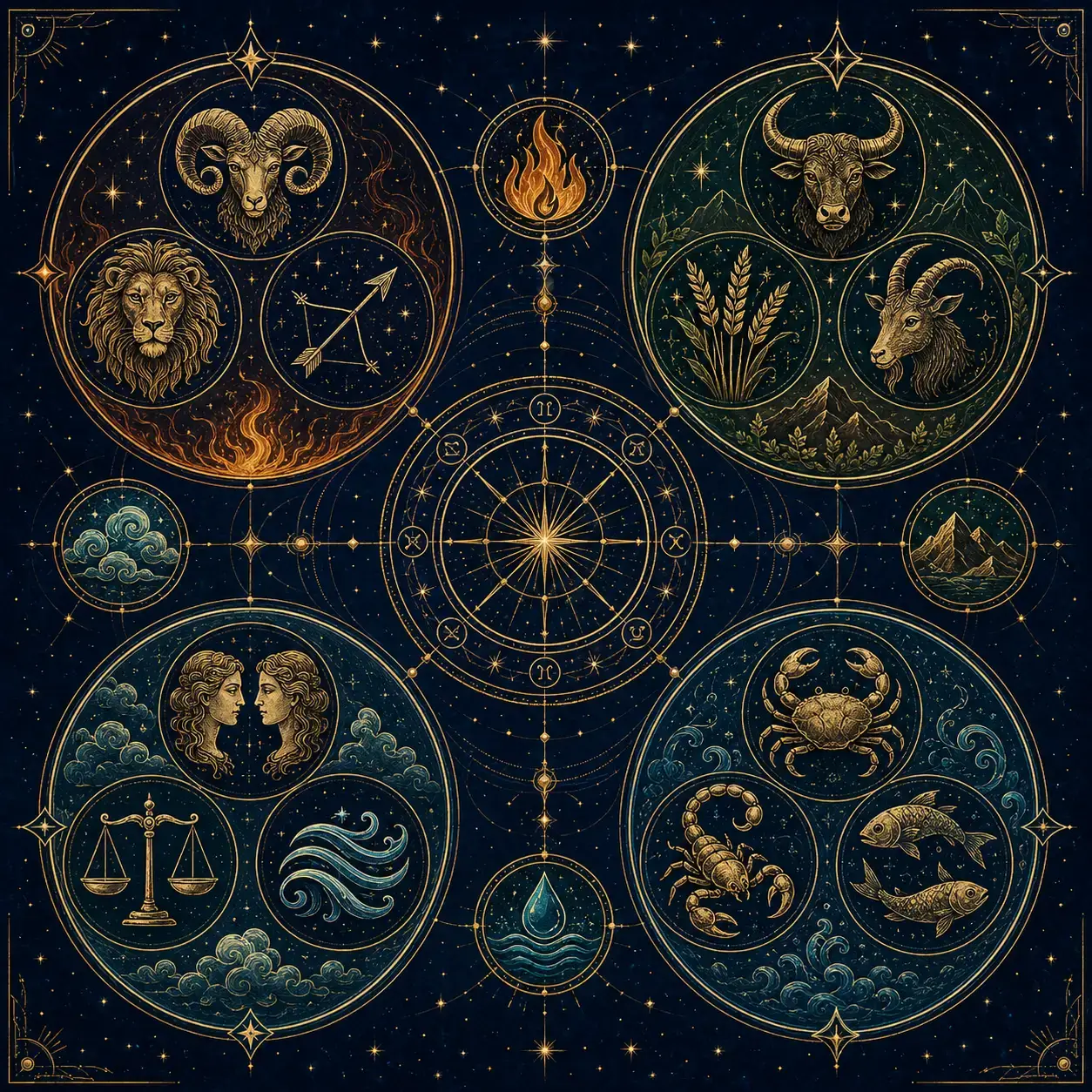
These elements matter because they shape the main tone of a chart. A person with many Fire placements may move fast and trust instinct, while someone with strong Earth energy may prefer structure and proof. In chart work, people often misread themselves because they only know their Sun sign — but the rest of the chart can point to a very different elemental balance.
To see the full mix, start with AIFATE's free birth chart and compare the element count across the Sun, Moon, Rising, and planets. That gives a clearer picture than Sun-sign astrology alone and makes it easier to spot repeated patterns in personality, relationships, and timing.
Astrology elements are the foundation of zodiac signs. They describe how energy is expressed — which is why they matter so much for compatibility, work style, and personal growth.
Fire Signs in Astrology: Aries, Leo, and Sagittarius
Fire signs astrology is about momentum, courage, and direct action. Aries starts quickly, Leo wants to shine, and Sagittarius looks for meaning, adventure, and honest truth. Fire signs personality traits often include confidence, enthusiasm, and a strong need to feel alive in what they do.
Fire is the element of initiation. People with strong Fire placements usually dislike waiting or overthinking every move. They often excel in jobs that reward fast decision-making, visible leadership, and independent drive. In love, Fire tends to be direct and expressive — and usually prefers chemistry that feels obvious rather than hidden.
The challenge is that Fire can burn too quickly. Impulsiveness, impatience, and short attention spans are common shadows, especially when life feels repetitive. A Fire-heavy person may start three projects at once, take on a bold situation, and then realize they need a plan to keep everything from scattering.
Here is a simple way to read Fire energy in daily life:
- Fire under stress can become sharp, restless, or argumentative
- Fire at its best is brave, creative, and motivating to others
- Fire needs motion, clear goals, and room to take the lead
Think of a Leo marketing manager who can pitch a new campaign in five minutes but gets frustrated by endless revisions. The solution is not to suppress the Fire — it is to give it a target, a deadline, and enough freedom to move with purpose.
Earth Signs in Astrology: Taurus, Virgo, and Capricorn
Earth signs astrology is about stability, practicality, and real-world results. Taurus builds comfort and security, Virgo refines and improves, and Capricorn works toward long-term goals. Earth signs characteristics often show up as patience, reliability, and a strong sense of what is actually workable.
Earth signs usually care about what can be tested, used, or maintained. They are often the people keeping the schedule, checking the budget, or making sure the plan is possible. In career settings, Earth can be excellent for operations, finance, craft, and planning — any role that rewards consistency over flash.
In relationships, Earth tends to show love through support, presence, and practical care. A Taurus may remember what helps someone feel safe. A Virgo may notice the small details that make life smoother. A Capricorn may show commitment by staying steady through pressure. The challenge is that Earth can become fixed or so focused on the practical side that emotion gets pushed aside.
Earth-heavy charts often need one reminder: security is not the same as control. When Earth becomes too rigid, it can hold on to routines long after those routines stop helping. One client with a Taurus Sun, Virgo Moon, and Capricorn Rising described feeling successful on paper but emotionally blocked — the chart made sense once she saw that Earth gave her endurance, but not flexibility.
Earth benefits from slow progress, clear systems, and visible results. If your chart leans Earth, ask whether your current habits support growth or simply protect the familiar.
Air Signs in Astrology: Gemini, Libra, and Aquarius
Air signs astrology is about ideas, language, perspective, and connection. Gemini gathers information, Libra weighs balance and social harmony, and Aquarius thinks in systems, trends, and future possibilities. Air signs traits in astrology often include curiosity, objectivity, wit, and a strong need to talk things through.
Air signs tend to process life through conversation and comparison. They like to understand why something is happening and how different choices fit together. That makes Air useful in writing, teaching, design, negotiation, and any setting where communication shapes results.
In relationships, Air often wants mental stimulation as much as emotional closeness. A Libra may care deeply about fairness. A Gemini may need variety and room to change their mind. An Aquarius may value friendship, freedom, and shared ideals. The shadow side is emotional distance, indecision, or staying in the idea of a relationship longer than the relationship itself.
Air signs can also become overactive in the mind. When that happens, thoughts multiply faster than action. A person with strong Air placements may talk through every angle, yet still avoid the final decision. That is not failure — it is a signal that the chart may need more grounding through routine, body-based habits, or clear deadlines.
A useful rule of thumb: Air needs information, but it also needs closure. Good Air energy asks questions, compares options, and then chooses a direction. Without that final step, the mind keeps circling.
Water Signs in Astrology: Cancer, Scorpio, and Pisces
Water signs astrology is about emotion, intuition, memory, and sensitivity. Cancer protects and nurtures, Scorpio goes deep and seeks truth, and Pisces absorbs, imagines, and empathizes. Water signs emotional nature is often private, receptive, and strongly shaped by atmosphere.
Water placements can feel what is not being said. They often read mood shifts quickly, notice tension in a room, and carry memories for a long time. In work, Water can be excellent in healing fields, creative roles, research, and counseling — any setting that depends on trust and emotional awareness.
In love, Water usually wants depth. These signs often look for loyalty, emotional safety, and a bond that feels meaningful rather than casual. A Cancer may protect loved ones through care. A Scorpio may need honesty and depth before they trust. A Pisces may blend compassion with imagination — and need quiet time to reset after too much noise.
The challenge with Water is boundary strain. Because Water is so receptive, it can absorb other people's moods, fears, and expectations. That can lead to emotional overload or staying in situations that feel familiar but draining. Water does best when it learns where its feelings end and someone else's begin.
A practical example: a Pisces project lead may be brilliant at sensing team morale, yet struggle when an office conflict becomes too blunt. The fix is not to become less sensitive — it is to add structure, quiet time, and a clear process for decision-making.
How to Find Your Dominant Astrology Element (Beyond Your Sun Sign)
Dominant element astrology looks at the whole chart, not just the Sun sign. Your main element usually comes from repetition across the Sun, Moon, Rising, Mercury, Venus, Mars, Jupiter, Saturn, and chart angles — plus any sign clusters that keep showing the same element. That is why elemental balance in a birth chart often surprises people who only know their Sun sign.
In practice, count the placements first, then look for emphasis. If three or more personal planets land in one element, that element often colors the chart strongly. A chart with a Taurus Sun, Gemini Moon, and Aquarius Rising may still feel Air-led in daily life because the mind and social style are both very active. You can generate your full natal chart to see your elemental distribution and check that pattern for yourself.
Use the checklist below as a starting guide.
| What to check | What it usually shows | Why it matters |
|---|---|---|
| Sun, Moon, and Rising | Core identity, emotional style, and outward behavior | These three placements shape your first layer of element balance |
| Mercury, Venus, and Mars | Thinking style, relating style, and action style | These often explain how the dominant element shows up day to day |
| Jupiter, Saturn, and chart ruler | Growth, structure, and life direction | These placements can strengthen one element across major life choices |
| Repeated signs and empty areas | Where energy clusters or feels less practiced | They help you spot missing elements and overused ones |
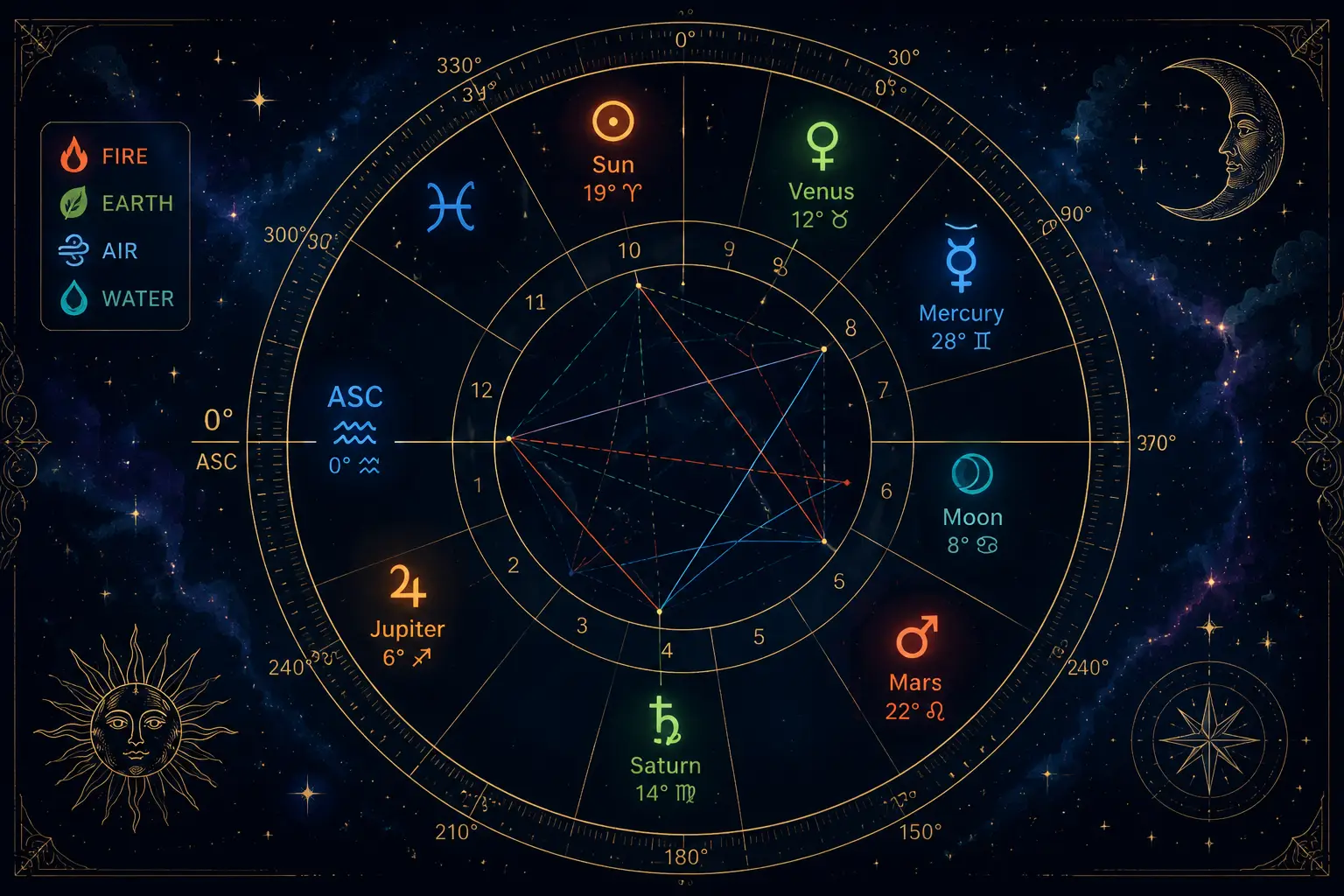
A good chart reading does not stop at the count — it asks how the element behaves. A dominant Fire chart can still act cautiously if Saturn is strong. A Water chart can look calm on the outside if Air placements handle the social front. If you also follow Vedic astrology, AIFATE's Vedic birth chart adds another lens for comparison.
A chart with one strong element is not broken. It simply points to a repeated style that wants support from the other three.
Astrology Element Compatibility: How Fire, Earth, Air, and Water Get Along
Element compatibility in astrology shows how different styles interact — but it does not decide a relationship by itself. Fire and Air often energize each other; Earth and Water often support each other. Fire with Water and Earth with Air may need more translation and patience. The best way to read zodiac compatibility by element is to treat it as a starting point, then compare the rest of the chart.
For relationship analysis, elemental chemistry becomes much clearer in a synastry chart. You can test the pattern with AIFATE's synastry chart or love compatibility chart to see which planets support ease, attraction, or friction. Pairing element work with a look at cardinal, fixed, and mutable qualities gives even more context, because the three modalities change how each element behaves.
| Element Pairing | Common Dynamic | Watch For | Helpful Approach |
|---|---|---|---|
| Fire + Air | Fast, playful, mentally active | Too much speed or scattered follow-through | Set goals and deadlines so ideas become action |
| Earth + Water | Supportive, loyal, steady | Too much caution or emotional dependence | Keep routines while leaving room for honest feelings |
| Fire + Water | Strong attraction and intense feeling | Mood clashes, heat, and hurt reactions | Slow the pace and name feelings early |
| Earth + Air | Practical ideas and useful planning | Ideas can feel unrealistic or too rigid | Translate concepts into steps, budgets, and timelines |
Same-element pairings also carry nuance. Fire with Fire can be exciting but competitive. Water with Water can be deeply empathetic but easy to overwhelm. Earth with Earth can build a lot, yet become stuck in habit. Air with Air can be brilliant in conversation, yet forget the body and the schedule. A relationship works best when the element mix gives both people something to offer and something to learn.
Balancing Astrology Elements: Practical Tips for Each Type
Balancing elements in astrology means giving more room to the element you lack and more structure to the one you overuse. The goal is not to become evenly split in every area — it is to create a chart life that feels workable, honest, and less reactive.
- Fire-heavy: Build pauses into your day, finish one task before starting another, and add cooling habits such as sleep, hydration, and post-work recovery
- Fire-light: Use movement, decisive goals, dance, sports, or short challenges to wake up initiative and confidence
- Earth-heavy: Keep routines, but avoid over-scheduling; add novelty through travel, new skills, or a small creative project
- Earth-light: Use calendars, meal planning, savings goals, and body-based routines to create steadier ground
- Air-heavy: Reduce information overload; write decisions down, set a stop time for thinking, and spend time offline
- Air-light: Read, journal, ask more questions, and practice clear communication before major choices
- Water-heavy: Protect your boundaries, schedule quiet time, and notice which people or places drain you
- Water-light: Make space for reflection, music, art, and honest emotional check-ins
Timing matters too. A Solar Return chart can show which element is emphasized for the year ahead, and a Transit Chart can show when that emphasis becomes active in real life. If 2026 feels more reactive, more productive, or more reflective than usual, check AIFATE's solar return chart and transit chart to see which element is being highlighted and when.
For many people, the fix is simple once the pattern is visible. A Fire person may need rest before ambition turns into burnout. An Earth person may need permission to change course. An Air person may need body routines. A Water person may need stronger boundaries. Small, consistent adjustments usually work better than dramatic reinvention.
FAQs About Astrology Elements
What are the four elements in astrology?
The four elements in astrology are Fire, Earth, Air, and Water. Each one groups three zodiac signs and describes a different style of energy. Fire is active and direct, Earth is steady and practical, Air is mental and social, and Water is emotional and intuitive. Together, the four astrology elements help explain personality, relationships, and life themes.
How do I know my dominant element in astrology?
Start with your Sun, Moon, and Rising signs, then look at Mercury, Venus, and Mars for more detail. A full birth chart gives a much better answer than Sun sign alone because one chart can hold several different element types. AIFATE's free birth chart tool makes it easy to count repeated elements and see which one leads your chart.
What happens if I have a missing element in my chart?
A missing element does not mean something is wrong with your chart. It usually means that style of energy feels less automatic and may take more conscious practice. For example, missing Earth can show up as inconsistent routines, while missing Water can show up as trouble naming feelings. The solution is usually simple: build habits that train the missing element instead of chasing it through a label.
Which astrology elements are most compatible?
Fire and Air often work well together because both like movement, ideas, and momentum. Earth and Water also tend to fit because one gives structure and the other gives feeling. That said, compatibility depends on more than just element — synastry, Moon signs, Venus and Mars placements, and the balance of cardinal, fixed, and mutable modalities all affect how two people actually relate.
Can my astrology element change over time?
Your natal element mix does not change, but its expression can feel different as transits, progressions, and solar returns shift the focus of the year. A person with a Fire-heavy chart may feel more grounded during an Earth-dominant transit season, or more emotional during a Water-heavy period. The birth chart stays the same, but the timing changes how it shows up in daily life.
About This Guide
This guide was written by Maya Rivers for the AIFATE Astrology Team. It combines Western and Vedic astrology with modern chart analysis and practical numerology insights. Last updated: June 2026.
Author

Lead Astrologer at AIFATE
Maya Rivers is the lead astrologer at AIFATE, where she bridges Western and Vedic astrology with practical numerology. With over a decade of birth chart interpretation experience and thousands of personal readings, she writes to help readers turn planetary language into everyday clarity.
Previous
Astrocartography Map: How Location Affects Your Astrology
Next
Astrocartography Map Generator: Find Your Best Location Free