Top 10 Free Synastry Chart Calculators for Accurate Readings in 2026
Compare the best free synastry chart calculators in 2026. See how planets, aspects, and house overlays reveal love, conflict, and compatibility — start with AIFATE's free AI reading, no signup required.
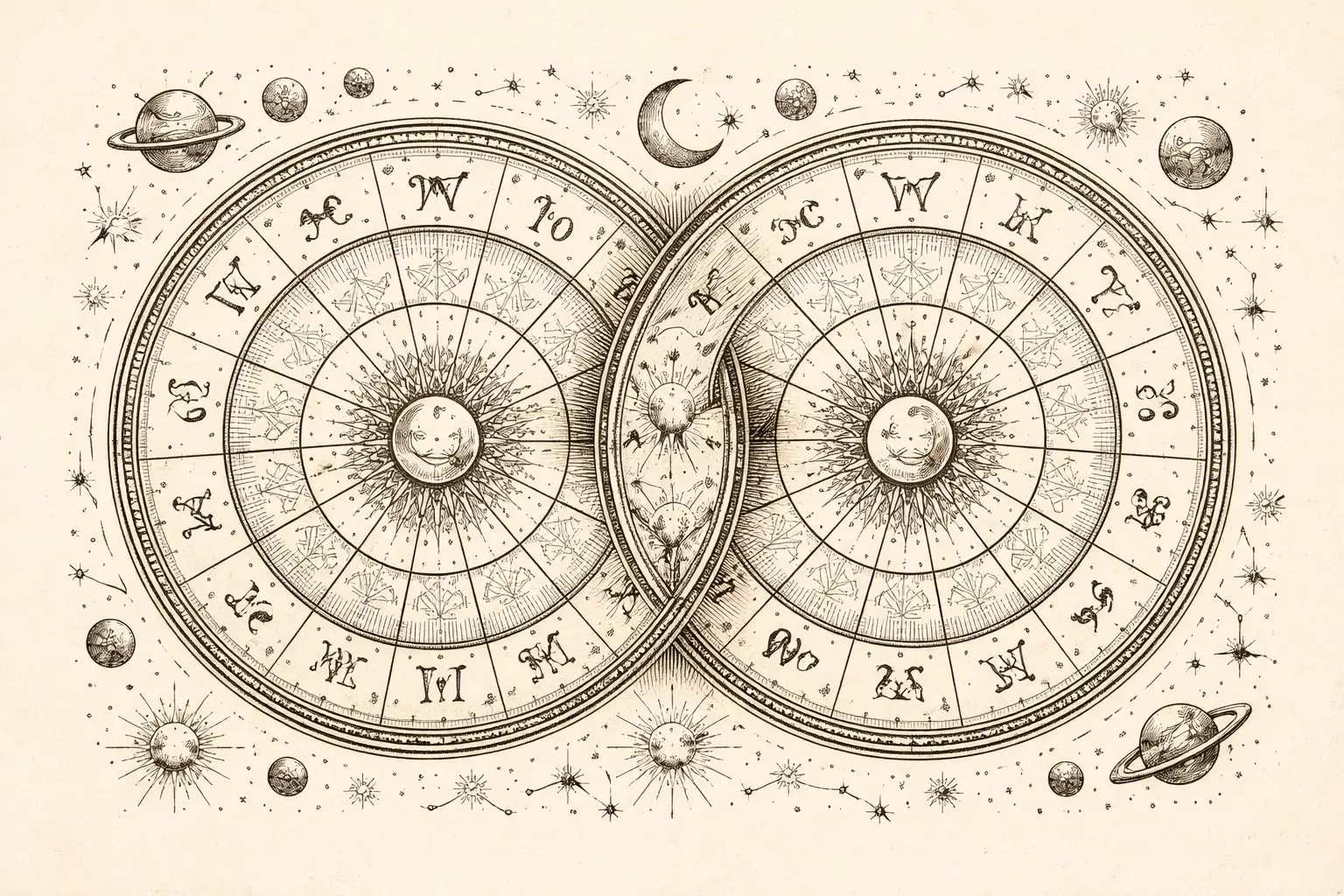
A synastry chart calculator is a free online relationship astrology tool that overlays two natal birth charts to reveal attraction, chemistry, tension, and long-term compatibility patterns. It answers practical questions about love, communication, trust, conflict style, and timing — going far deeper than a simple Sun-sign match score. This guide explains how synastry works, what to look for in a free synastry chart tool, compares the top 10 free synastry chart calculators for 2026, and shows how to use AIFATE's AI-assisted reading to get clearer results.
Quick picks — best free synastry chart calculators in 2026:
- Best AI-assisted free synastry calculator: AIFATE free synastry chart calculator — no signup required, instant results
- Best for technical detail and aspect grids: Astro-Seek synastry calculator
- Best for unknown birth times and Special Points: AstroLibrary compatibility report
- Best beginner-friendly option: Cafe Astrology compatibility report
- Best mobile app: TimePassages or AstroMatrix
What Is Synastry and Why It Beats Basic Love Calculators
A basic love compatibility tool usually compares only Sun signs or returns a single percentage score. Synastry compares two full natal charts — every planet, every house position, every angle. That is why two people with identical Sun signs can feel completely different in a relationship: the real story is in the Moon, Venus, Mars, Saturn, and where each planet falls in the other person's life areas.
Couples who look perfect on paper sometimes struggle because one person's Moon squares the other's Saturn, while another pair with seemingly mismatched Sun signs feels remarkably steady because their Moons, Venuses, and Saturns support each other. A free synastry chart calculator makes that difference visible instead of hiding it behind a vague score. If you need the individual placements first, use AIFATE's free birth chart calculator before comparing two charts.
A synastry chart does not tell you if a relationship will work. It shows where the ease, friction, and attraction are most likely to show up — and that is far more useful than a number.
How Synastry Charts Go Beyond Sun-Sign Compatibility
Synastry works by comparing the whole chart: Sun, Moon, Mercury, Venus, Mars, Jupiter, Saturn, and the house positions each planet lands in when overlaid on the partner's chart. The result is a precise map of attraction, emotional rhythm, communication style, and stress points.
- Sun — core identity, ego, and life direction
- Moon — emotional rhythm, comfort needs, and self-soothing style
- Venus — affection, aesthetic, and what feels pleasurable
- Mars — desire, drive, and how tension gets expressed
- Mercury — communication style, thinking patterns, decision-making
- Saturn — commitment, responsibility, endurance, and long-term pressure
How a Synastry Chart Calculator Works: Planets, Aspects, and House Overlays
A synastry chart calculator takes both people's birth data, calculates planetary positions for each exact moment, then lays one chart over the other and measures the angles between planets. Those angles are called aspects. The tighter the orb — the fewer degrees off the exact angle — the stronger the contact. A 1-degree Venus-Mars conjunction typically feels far louder in daily life than an 8-degree one.
The Six Main Aspects in Synastry and What They Mean
| Aspect | Degrees | Dynamic | Example in relationships |
|---|---|---|---|
| Conjunction | 0° | Intense fusion — energies merge | Sun conjunct Moon: instinctive understanding, you "get" each other |
| Trine | 120° | Effortless harmony and flow | Venus trine Mars: natural attraction, easy give-and-take |
| Sextile | 60° | Gentle opportunity and cooperation | Mercury sextile Mercury: think alike, conversations stay interesting |
| Opposition | 180° | Magnetic tension — opposites attract | Sun opposition Moon: you differ but complement each other |
| Square | 90° | Friction that forces growth | Venus square Mars: intense sexual tension, passionate but challenging |
| Quincunx | 150° | Constant adjustment needed | Moon quincunx Venus: emotional and affection styles require ongoing effort |
The Role of Personal Planets in Compatibility
Personal planets do most of the daily relationship work. Sun-to-Sun contacts shape how two people see life together. Moon contacts reveal whether they feel emotionally safe with each other. Venus and Mars contacts govern attraction and desire. Mercury contacts shape whether conversations flow or stall. Saturn contacts decide whether the relationship builds lasting structure or fades under pressure.
A pattern that shows up repeatedly: couples who communicate well but struggle emotionally often have strong Mercury contacts and weak Moon contacts. The reverse is equally common — intense initial attraction with little long-term follow-through when Venus and Mars are strong but Saturn is absent entirely. That is exactly why a synastry chart calculator gives more reliable relationship insight than any single compatibility score.
Understanding House Overlays and Attraction Patterns
House overlays show where one person's planets land in the other person's life areas. Venus in the partner's 5th house feels playful and romantic. Mars in the 7th house brings direct partnership focus. Planets in the 8th house intensify trust, emotional depth, and shared vulnerability. A planet in the 10th house can tie the relationship to career, reputation, or long-term goals.
A practical example: when one person's Mars falls in the partner's 10th house, the attraction is often immediate — but so is a quiet recurring pressure around ambition and public image. Once that overlay is visible in the chart, recurring tension around work topics stops feeling personal and starts making structural sense. For timing questions, AIFATE's transit chart shows when a current planet is activating a natal or synastry theme in real time. The Venus sign calculator and Mars sign calculator add useful attraction context before you run the full synastry comparison.
Synastry vs Composite Charts: Which Relationship Chart Do You Need?
Synastry compares two people directly and shows how each person's chart activates the other's. Composite merges both charts into one shared chart and treats the relationship itself as a single entity. For dating, conflict analysis, and communication patterns, synastry comes first. Composite becomes useful once the relationship is established and you want to understand the bond as a whole unit.
| Factor | Synastry | Composite |
|---|---|---|
| Purpose | Shows how two charts interact | Shows the relationship as a single shared chart |
| Data used | Two natal charts placed against each other | Midpoints of both charts blended into one |
| Best for | Dating, attraction, conflict patterns, communication | Long-term bond, shared identity, joint direction |
| What it reveals | Who triggers what, where chemistry and friction live | What the relationship feels like as a shared unit |
| Limitation | Can feel busy without clear interpretation | Does not show which person brings which pattern |
When to Choose Synastry Over Composite
Choose synastry first if you are dating, deciding whether to invest more time, or trying to understand a recurring conflict. If birth times are uncertain, synastry still gives useful planet-to-planet contacts even when the house picture is softer. That makes it the better first tool for most people starting a free relationship astrology reading. For annual timing, pair the synastry with the solar return chart to see which relationship themes are most active in the current year.
What AIFATE's Free Synastry Chart Calculator Includes
Before choosing any synastry tool, it helps to know exactly what you will receive. Here is what AIFATE's free synastry chart calculator provides:
- Aspects reading — detailed interpretation of the planetary contacts between both charts, in plain English
- Aspects list with orbs — every synastry aspect shown with its exact orb so you can see how strong each contact is
- House overlays list — where each person's planets fall in the other's houses (requires birth time for accurate results)
- Synastry chart biwheel visual — both natal charts overlaid and displayed together
- AI-assisted summary — a plain-language synthesis of the most significant relationship themes, attraction patterns, and recurring dynamics
- No-birth-time mode — planet-to-planet aspects still calculated and interpreted when birth time is unknown for one or both partners
No signup required. Results are instant. Run your free synastry chart on AIFATE here.
How We Evaluated These Synastry Chart Calculators
We tested each platform using the same two birth profiles — including one set with an uncertain birth time — and scored them on four criteria: accuracy of aspect and house overlay calculations; interpretation depth beyond a percentage score; free access without requiring signup or payment upfront; and usability on both desktop and mobile.
All tools in the table below allow free synastry comparison at a basic level. Paid tiers and limitations are noted where relevant. We also cross-referenced community feedback from astrology forums including Reddit r/astrologymemes' master list of free calculators to verify which platforms consistently deliver reliable results.
Top 10 Free Synastry Chart Calculators for Accurate Relationship Insights in 2026
The best synastry sites in 2026 combine accurate calculation, house overlays, and readable interpretation instead of stopping at a compatibility score. The table below shows which tools give the most without charging upfront.
| Rank | Tool | Best for | Works without birth time? | Free access |
|---|---|---|---|---|
| 1 | AIFATE | AI-assisted reading, house overlays, plain-English summary, no signup | Yes | Free |
| 2 | Astro-Seek | Detailed aspect grids, full house system options, technical users | Yes | Free |
| 3 | AstroLibrary | 12 house systems, Chiron/Lilith/North Node aspects, privacy-first | Yes | Free |
| 4 | Astro.com | Classic accuracy, trusted by professional astrologers for decades | Yes | Free or freemium |
| 5 | Cafe Astrology | Readable beginner-friendly explanations, no overwhelming detail | Yes | Free |
| 6 | TimePassages | Polished app experience with deeper interpretation layers | Limited | Freemium |
| 7 | AstroMatrix | Mobile-first compatibility reading, clean quick interface | Limited | Freemium |
| 8 | Co-Star | Quick relationship prompts and social-style astrology experience | No | Free or freemium |
| 9 | The Pattern | Emotional timing and recurring relationship themes | No | Free or freemium |
| 10 | Astrology.com | Easy entry-level compatibility, familiar to mainstream users | Yes | Free or freemium |
AIFATE: Best Free AI-Assisted Synastry Chart Calculator
AIFATE turns a full synastry calculation into clear English rather than jargon-heavy output. It compares two birth charts, identifies the most significant aspects with their orbs, shows house overlays, and synthesizes the results into a plain-language relationship summary. No account is required and results are instant. Try AIFATE's free synastry chart calculator here.
AIFATE is the platform we maintain, so we have more direct testing experience with its synastry calculator than with any other tool in this list. We tested all 10 platforms against the same birth data before ranking. For a lighter summary after the full comparison, the love chart gives a quicker read on overall chemistry.
Astro-Seek: Best for Technical Chart Data
Astro-Seek is the strongest free option for readers who want aspect grids, full house system flexibility, and maximum chart comparison depth. The layout is dense but packed with data, and it is consistently recommended across astrology communities as a reliable free benchmark for both natal and relationship charts.
AstroLibrary: Best for Unknown Birth Times and Advanced Features
AstroLibrary handles missing birth times with full transparency. If neither partner's time is known, it still calculates all planet-to-planet aspects including North Node, Black Moon Lilith, and Chiron. With at least one birth time, it adds Moon, Ascendant, Midheaven, Vertex, and Part of Fortune contacts. It also offers 12 house system choices including Placidus, Whole Sign, Koch, and Campanus, making it the strongest free option for advanced readers. Privacy is explicit: data is not stored after the report is generated.
Websites vs Apps: Which Should You Choose?
For a first synastry reading, websites usually win because they show the biwheel chart, orbs, and house overlays in a format that is easier to compare and study. Apps like TimePassages and AstroMatrix are most useful for daily relationship check-ins and transit alerts on mobile, but the natal synastry calculation should be verified on a desktop-capable site first. If you want a smooth starting point with no setup, the AIFATE free synastry chart calculator works cleanly on both desktop and mobile.
Free vs Paid Synastry Tools: What Is Worth Paying For?
Free tools are enough for a first-pass reading when they include aspects, house overlays, and orb data. Paid tools become worth it when you want saved chart history, professional astrologer input, or a relationship dashboard with ongoing transit tracking.
- Use free tools for chemistry, house activation, and initial compatibility questions
- Pay when you want saved history, professional interpretation, or sustained relationship tracking
- Choose a paid report only after the free chart has answered the primary compatibility question
For timing, AIFATE's solar return chart and transit chart often give more practical value than an upgraded compatibility percentage, because they show which synastry themes are being activated right now in real time.
Compatibility is not just about attraction. The useful question is what happens when daily life, pressure, and timing all show up at the same time.
How to Read a Synastry Chart Step by Step in 2026
The fastest way to get a usable reading is to verify birth data first, then read the chart in layers from most personal to most structural.
- Enter both people's birth date, time, and birthplace into AIFATE's free synastry chart calculator. If one person's birth time is unknown, enter 12:00 PM and treat house overlays as approximate until the time is confirmed.
- Start with Moon-to-Moon and Sun-to-Moon contacts. These reveal the emotional foundation of the relationship before attraction or conflict patterns are layered on top.
- Check Venus and Mars contacts for attraction and desire dynamics. Venus trine Mars usually indicates natural easy chemistry. Venus square Mars adds intensity and friction.
- Look at Saturn contacts. Saturn conjunct, square, or opposite a personal planet creates pressure but also adds durability when both people are honest about it.
- Read the house overlays: where does each person's Sun, Moon, Venus, Mars land in the other's chart? The house it activates shows which life area the relationship most strongly affects.
- For 2026 timing, check AIFATE's transit chart to see which synastry themes are currently being triggered by ongoing planetary transits.
If you want deeper context on individual placements before running the comparison, the Venus sign calculator, Mars sign calculator, and the article Sun, Moon and Rising Signs Explained all add useful grounding. For career or business partnerships, focus the same synastry reading on Mercury, Saturn, the 6th house, and the 10th house instead of the romantic factors.
Synastry for Career, Business, and Money Compatibility
Synastry is not only for romantic relationships. The same chart comparison can show how two people function under work pressure, who tends toward strategy vs. execution, whether communication styles align, and where friction around authority or shared responsibility is most likely to surface. Mercury, Saturn, the 6th house, and the 10th house carry the most weight in a professional synastry reading.
For money compatibility specifically, Venus, Jupiter, the 2nd house, and the 8th house are the most relevant factors. They can reveal differences in spending style, risk tolerance, and comfort with pooling resources. Synastry will not replace a financial plan, but it can explain recurring disagreements about money before they become entrenched patterns. If the bond is both personal and professional, compare the synastry with each person's individual birth chart and the current transit chart to see the full picture.
FAQ: Common Questions About Synastry Charts and Love Compatibility Tools
What is the best free synastry chart calculator in 2026?
For most users, AIFATE's free synastry chart calculator is the strongest starting point in 2026 because it combines accurate calculations with a plain-English AI summary, includes house overlays, requires no signup, and works even when one person's birth time is unknown. For maximum technical control including 12 house system options and Special Points like Chiron and Lilith, AstroLibrary is the best free alternative. For beginners, Cafe Astrology is the most accessible option.
What is the difference between synastry and composite charts?
Synastry compares two people side by side so you can see how one chart activates the other. Composite charts merge both into one shared chart that describes the relationship as its own entity. For dating, conflict patterns, and attraction, synastry usually comes first. For long-term bond analysis and shared identity, composite is the better second layer.
Do I need my partner's exact birth time for a synastry chart?
An exact birth time makes house overlays, Ascendant contacts, and Moon placement more precise. Without it, a synastry chart can still compare all planet-to-planet aspects and deliver a strong reading of attraction, communication, and emotional patterns. Tools like AIFATE and AstroLibrary both handle missing birth times explicitly — they show you what can and cannot be calculated so you know how much to rely on the house picture.
Are free synastry chart calculators accurate enough for real readings?
Yes, if the birth data is correct. The math behind reputable free tools is the same as in professional software — most use Swiss Ephemeris precision. Most errors come from wrong birth times, unclear timezone handling, or calculators that only show percentages instead of actual aspects with orbs. Always confirm birth data before judging the interpretation.
Can I trust AI-generated synastry readings?
Yes, when the AI is working from real chart data and explaining actual placements rather than producing generic phrases. A trustworthy AI synastry reading always names the specific aspect or house overlay it is describing so you can check the logic directly against the chart itself.
How do I interpret challenging aspects in a synastry chart?
Start by asking what the aspect type is designed to do. Squares create friction that demands action and growth. Oppositions create magnetic pull with complementary differences that need balancing. Saturn contacts feel heavy but provide endurance when both people engage honestly. Look at the whole pattern before drawing conclusions — one supportive trine often softens a difficult square considerably. Orbs of 3 degrees or less tend to matter most in day-to-day experience.
Are there free synastry chart tools that include house overlays?
Yes. AIFATE's free synastry chart includes house overlays and an AI-assisted plain-English summary. AstroLibrary also provides house overlays for free when at least one person's birth time is available. Astro-Seek includes house overlay data in its free comparison tool as well. If a tool only returns a percentage without showing individual aspects and house placements, it is too thin for real relationship chart work.
Can synastry show money or career compatibility?
Yes. Venus, Jupiter, the 2nd house, and the 8th house reveal financial compatibility — spending style, risk appetite, and comfort with shared resources. Mercury, Saturn, the 6th house, and the 10th house are most relevant for career and work partnership dynamics. Synastry will not replace a financial plan, but it can explain why two people who trust each other still clash consistently about money or work priorities.
What is the practical first step for using a synastry chart?
Run AIFATE's free synastry chart calculator with both sets of birth data, then read the Moon and Venus contacts first. Once you have the emotional and affection picture, look at Saturn and Mars contacts for friction and structure. Finally check the house overlays to see which life areas are most activated by the relationship. That three-layer sequence gives a cleaner, more actionable answer than starting with a Sun-sign score and working backward.
About This Guide
This guide was prepared by the AIFATE Astrology Team in June 2026. Our team has tested Western synastry chart tools for over eight years, including direct work with relationship readings for users across the US, UK, Canada, and Australia. We tested all 10 platforms listed above against the same birth data profiles before ranking them. AIFATE is the AI-assisted relationship astrology platform we maintain — which means we have more hands-on experience with its synastry calculator than with any third-party tool in this list. The guide draws on Western astrology chart analysis, practical synastry methodology, and community feedback from forums including Reddit r/astrology and r/astrologymemes. Last updated: June 2026.
Author

Lead Astrologer at AIFATE
Maya Rivers is the lead astrologer at AIFATE, where she bridges Western and Vedic astrology with practical numerology. With over a decade of birth chart interpretation experience and thousands of personal readings, she writes to help readers turn planetary language into everyday clarity.
Previous
Top 10 Free Birth Chart Calculators for Accurate Natal Charts in 2026
Next
Astrocartography Map: How Location Affects Your Astrology