Composite Chart in Astrology: Meaning, Calculation, and Interpretation
Learn what a composite chart in astrology means, how it is calculated, and how to interpret it in relationship astrology.

In short, synastry shows how two people affect each other, a composite chart calculator blends both charts into one relationship chart, and a Davison chart adds a timing layer. This guide walks you through how composite charts work, how to use a composite chart calculator step by step, and how to read the key houses, aspects, and interpretation order without getting lost.
A composite chart calculator is a tool that combines two natal charts into one relationship chart using planetary midpoints. It helps with love, trust, money, timing, identity, and the way two people function together over time. Whether you are analyzing a romantic partnership, a close friendship, or a business collaboration, the composite method gives you a single astrological wheel that represents the shared entity rather than either individual. If you need each person's baseline first, start with a free birth chart, then use this article to understand what the shared chart is showing and how to read it with less guesswork. For a quick relationship overview, you can also compare two charts with AIFATE's synastry chart before moving to the composite view.
What Is a Composite Chart in Astrology?
A composite chart is a relationship chart built from the midpoints of two natal charts. Instead of asking what one person is like, it asks what the relationship itself is like once both charts are blended into a single wheel. In practice, that means the chart can describe the tone of a romance, the working style of a business partnership, or the emotional pattern inside a family bond. This midpoint method, widely used in modern Western astrology, was popularized by astrologer Robert Hand in his landmark 1975 work Planets in Composite and is now a standard tool in relationship astrology and synastry interpretation.
The math behind a midpoint composite chart is simple in concept, even if the software does the heavy lifting. For each planet, the midpoint between the two natal placements is calculated, and those midpoint values are used to create the new chart. The result is not a symbolic overlay and not a fake chart. It is a separate relationship chart with its own angles, houses, and aspects — and astrologers read it as a third entity that exists between the two people.
Unlike a bi-wheel or synastry overlay, the composite chart uses the same chart structure you already know: twelve houses, zodiac signs, planetary positions, and aspect patterns such as conjunctions, squares, trines, and oppositions. What changes is the source: each placement is a midpoint, not a natal degree, so the chart belongs to the bond rather than to either person.
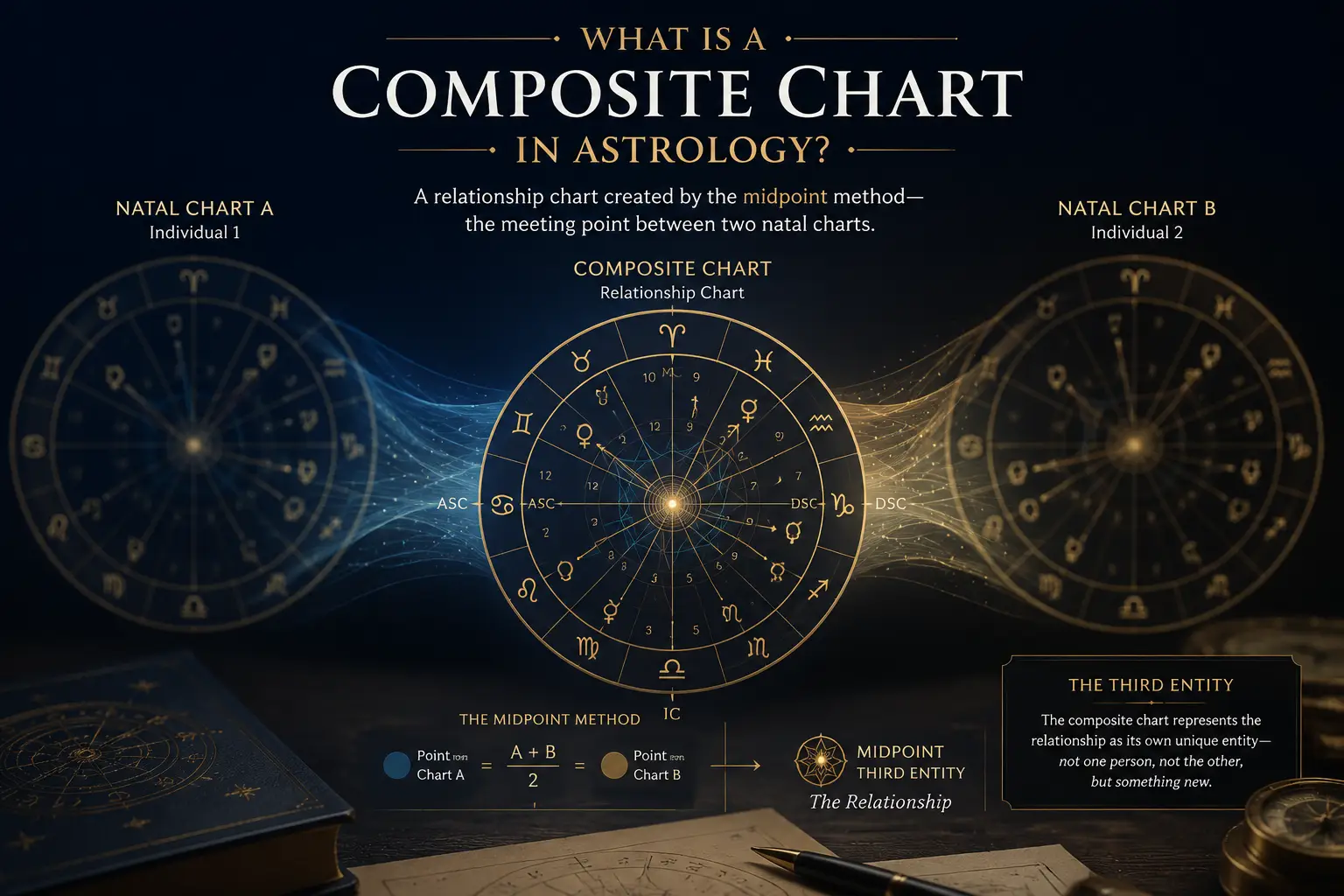
How is a midpoint composite chart calculated?
A midpoint composite chart is calculated by finding the halfway point between each pair of corresponding planets, then plotting those midpoint positions into one chart wheel. If one person has the Sun at 10 degrees Aries and the other has the Sun at 10 degrees Gemini, the composite Sun lands near 10 degrees Taurus. The same process is repeated for the Moon, Mercury, Venus, Mars, Jupiter, Saturn, Uranus, Neptune, Pluto, and the chart angles.
This is why the chart feels so different from reading two birth charts side by side. The midpoint method does not ask which person is more intense or more emotional. It asks what form the bond itself takes when both energies meet in the middle. The resulting planetary positions reflect shared tendencies, not individual traits — which is why experienced astrologers always read the composite chart alongside the natal charts rather than in place of them.
What does a relationship composite chart describe?
A relationship composite chart describes the shared tone, purpose, and pressure points of the bond. It can show how the relationship wants to be seen in the world, how it handles emotional needs on a day-to-day basis, where friction builds over time, and what kind of future the partnership tends to build if both people keep showing up. Key themes include shared values, communication style, attachment patterns, financial behavior as a unit, and the way the pair handles stress or conflict. In many cases, the chart reads more clearly after the pair has been together for a while, because the relationship has had time to express itself through real events.
In chart work, I often see people expect the composite chart to answer every question about attraction or chemistry. It does not do that alone. It describes the relationship as one living unit, which is useful for romance, but also for siblings, parent-child dynamics, close friends, and business partners. The emotional intelligence of the composite chart lies in describing what the bond tends to become rather than what each individual person brings to it.
Who should use a couple chart?
A couple chart is useful for any relationship where two people are building a shared reality. That includes:
- romantic partners who want to understand shared purpose, long-term tone, and emotional compatibility
- friends who keep repeating the same emotional pattern and want insight into the relational dynamic
- family members who need clarity around roles, support, and emotional distance
- business partners who want to see money, responsibility, and public direction more clearly
- therapists and counselors who use astrology as a supplementary lens in relational work
If the connection affects daily life, a composite chart can help describe it. It is especially useful when the relationship feels more real than the labels around it, because the chart shows the bond as its own structure with its own astrological signature.
A composite chart tells you what the relationship tends to become. It does not replace the two natal charts; it shows the shared shape that forms between them.
Composite Chart vs Synastry vs Davison: What's the Difference?
Synastry compares two charts, a composite chart blends them, and a Davison chart times them into a real midpoint chart based on the midpoint in time and geography between two births. Each method answers a different question, so it helps to know which one you need before you read too deeply. If you want to compare attraction and tension first, use AIFATE's free synastry chart tool and then move to the composite chart for the shared story.
| Chart type | What it measures | Best use case | Main limitation |
|---|---|---|---|
| Synastry | How one person's natal placements interact with the other person's natal placements | Attraction, friction, ease, and immediate chemistry between individuals | Shows interaction, not the relationship as a single unit |
| Composite | The midpoint relationship chart formed from both natal charts | Shared identity, purpose, tone, and long-term relational pattern | Can hide individual behavior if used without natal context |
| Davison | A real chart cast for the midpoint in time and place between two births | Timing, life-cycle themes, and a more event-based relationship view | Less intuitive for readers who want a symbolic relationship profile |
| Quick takeaway | Use synastry for contact, composite for the bond, Davison for timing | Choose the method that matches your question | No single chart gives the full picture by itself |
What does synastry show in relationship astrology?
Synastry shows how two charts interact on a person-to-person level. It is the best place to look for attraction, ease, trigger points, protective instincts, and the way one person affects the other's moods or choices. A strong Venus-Mars interaspect might explain desire and physical chemistry, while a tight Moon-Saturn contact might explain caution, duty, or emotional weight between two people. Synastry works in the language of individual planets touching individual planets across two birth charts.
What does a composite chart show that synastry does not?
A composite chart shows the shared identity of the bond itself. It answers questions like: What kind of relationship is this at its core? How does it behave when the pair functions as a unit? What keeps it alive through difficulty? Where does it strain when pressure builds? That makes the composite especially useful when the relationship has moved past first impressions and needs a clearer read on shared direction, communication patterns, and long-term compatibility. Synastry tells you why two people react to each other; composite tells you what they have become together.
How is a Davison chart different from a composite chart?
A Davison chart uses an actual midpoint in time and place between two births — it is a real horoscope cast for a real moment — while a composite chart uses midpoint math on planetary positions without casting a new horoscope. In practice, many astrologers read the Davison chart as more event-linked and the composite chart as more like a living relationship profile. If you are choosing one chart first, pick the composite for meaning and identity, and the Davison for timing questions and life-cycle patterns. Both are legitimate tools; they simply answer different questions within relationship astrology.
The quickest rule is simple: synastry explains why two people react to each other, composite explains what the relationship becomes as its own entity, and Davison can help show how the bond moves through time. That sequence keeps the reading practical instead of random.
How Do You Use a Composite Chart Calculator Step by Step?
A composite chart calculator needs two complete birth profiles, and it works best when you treat the output as a relationship profile rather than a prediction machine. Give it the two birth dates, times, and locations, then save the wheel before you start interpreting patterns. Using a free composite chart calculator is straightforward once you have both birth records ready. If you want to compare chemistry and friction against the shared chart, you can use AIFATE's free synastry chart tool alongside it for the fullest picture.
- Gather both birth records. Use the date, exact time, and place of birth for each person. If a birth time is missing, you can still calculate the relationship chart, but house placements, angular positions, and the composite Ascendant become unreliable.
- Enter both profiles into the calculator. The tool will generate the midpoint chart from both natal charts and place the composite planets into one wheel. Most online tools also show the house cusps and aspect grid automatically.
- Review the chart wheel and tables. Look at the Ascendant, Midheaven, angular house placements, and major aspect patterns before jumping to single planets. Angular placements — planets in the 1st, 4th, 7th, or 10th house — carry the most weight in composite interpretation.
- Save the output. Screenshot the wheel, note repeated house clusters, and write down the tightest aspects with the smallest orb so you can compare them to current transits and progressions later.
- Cross-check with synastry. Use the composite chart to read the bond's identity, then compare it with synastry so you understand whether the relationship feels consistent with what the composite chart describes structurally.
What birth data do you need before you calculate?
The more exact the birth data, the cleaner the reading. Dates and locations matter, but the exact birth time matters most for houses, angles, and the chart ruler. The composite Ascendant can shift by an entire sign if one person's birth time is off by an hour. If one person does not know their birth time, the composite can still offer useful planetary information through sign placements and major aspect patterns, yet the house emphasis should be treated as provisional rather than definitive.
That matters in real life. A client who runs a small marketing agency may have a composite chart that looks very public and career-focused, but if the partner's birth time is unknown, the 10th-house emphasis could be partially off. In that case, I would still trust the planetary pattern — the signs, the aspects, the stellium if one exists — but I would avoid overclaiming about the angular houses or the chart ruler's influence.
What will the composite chart calculator generate?
Most relationship chart astrology tools generate more than a single wheel. Expect to see a chart image, a list of planetary positions by sign and degree, house placements, a major aspect grid, and often a short written summary. The useful part is not just the image. It is the combination of the visual chart and the data table, because the table helps you spot the tightest aspect patterns — those with an orb under three degrees — much faster than the visual alone.
- the composite chart wheel with house cusps
- planet degrees and signs for all major bodies
- house positions for each composite planet
- major aspects between the composite planets with orbs
- often a brief interpretation summary for the Sun, Moon, and angles
What should you save before you interpret?
Save the chart before you read it, because you will want to compare it with the natal charts and with current transits later. At minimum, save the composite Ascendant, Sun, Moon, Venus, Mars, Saturn, and any planet sitting on an angle within five degrees. Those are the placements that usually tell the clearest story first and hold up best across multiple readings.
If the relationship feels confusing, return to the saved chart and compare it with the exact question you are asking. A composite chart is easier to understand when you read it against real events: a move, a breakup conversation, a shared financial decision, a promotion, or a period of emotional distance. Real-world anchors help you verify which chart themes are actually active.
How Do You Read Composite Chart Interpretation in the Right Order?
Composite chart interpretation is easier when you read the chart in a fixed order instead of chasing the first placement that catches your eye. In chart work, I often see readers jump straight to Venus or Saturn and miss the main structural story. The correct order is: angles first, then Sun and Moon, then personal planets, then outer planets and generational themes, and finally house emphasis and the chart ruler. If you want a quick compatibility check while you read, you can check relationship compatibility with AIFATE's love chart.
| Priority | Placement or factor | What to check | What it usually means |
|---|---|---|---|
| 1 | Angles | Ascendant, Descendant, Midheaven, and Imum Coeli | The relationship's visible style, private emotional foundation, and shared direction |
| 2 | Sun | Sign, house, and aspects to the composite Sun | The core identity, purpose, and vitality of the bond |
| 3 | Moon | Emotional needs, daily habits, and security patterns | How the relationship feels on an ordinary day and what it needs to feel safe |
| 4 | Venus and Mars | Attraction style, affection, initiative, and conflict patterns | What draws the pair together and what generates movement, desire, or friction |
| 5 | Saturn | Commitment, pressure, responsibility, patience, and delay | What holds the bond together when life becomes harder or the relationship is tested |
| 6 | Outer planets | Uranus, Neptune, and Pluto contacts and house positions | Change, idealism, intensity, power dynamics, or long-cycle transformation themes |
| 7 | House emphasis and chart ruler | Repeated house clusters, stelliums, and the ruler of the composite Ascendant | The main life area where the relationship consistently spends its energy and attention |
Angles tell you how the relationship shows up to the world and how it behaves in private. A composite Ascendant in Virgo can make the bond feel careful, practical, and detail-aware in all its dealings, while a composite Midheaven in Leo may push the pair toward public visibility, creative expression, or a leadership role together. Those two points often explain the outer shape and ambition of the relationship before you look at anything else. Angular planets — any planet within five to eight degrees of the Ascendant, Descendant, IC, or MC — amplify that story significantly and should be prioritized.
The Sun and Moon are the emotional core of the reading. The Sun shows the reason the bond exists and the direction it wants to move, while the Moon shows what the relationship needs in ordinary life to stay emotionally regulated and stable. A composite Sun in the 7th house may center the partnership itself as the primary purpose, while a composite Moon in the 4th can point to shared domestic rhythm, the need for a home base, and a strong pull toward privacy and emotional safety. Sun-Moon aspects in the composite chart — especially conjunctions, trines, and squares — often describe the fundamental ease or tension in the emotional life of the relationship.
Venus and Mars describe how the pair gives, receives, and acts. Venus shows what feels pleasant, cooperative, and mutually appealing; Mars shows where the bond wants action, directness, or heat. I often see couples with a strong Venus-Mars conjunction or trine in the composite get along easily in social settings but need clearer Mars expression when it comes to decision-making, sexual energy, or conflict resolution. When Venus and Mars are in tension — say, in a composite square — the pair may alternate between desire and frustration in a recurring pattern that benefits from direct conversation rather than avoidance.
Saturn changes the reading quickly, because it reveals where the relationship meets practical reality. A composite Saturn in strong aspect to personal planets can bring loyalty and staying power, but it can also bring fear, delay, or the sense that one person carries disproportionate responsibility. That does not make the bond problematic. It means the relationship wants structure, and without agreed-upon structure, the same Saturnian pressure can convert into resentment or emotional withdrawal. A composite Saturn in the 4th house might ask the pair to build a stable home; in the 8th, it may call for honest reckoning with shared finances or emotional debts.
Outer planets describe themes that are harder to control but still very visible over time. A composite Uranus contact — especially to the Sun, Moon, or angles — can bring the need for freedom, independence, or unexpected change into the heart of the relationship. Neptune contacts can describe idealization, spiritual connection, artistic collaboration, or — when afflicted — confusion and unspoken expectations. Pluto contacts in the composite chart often generate intensity, obsessive attachment, power struggles, or deep psychological transformation that neither person anticipated when they first connected. These contacts tend to matter most after the first few months, once the relationship has built enough history to reveal its underlying pattern.
House emphasis is the last piece because it tells you where the relationship keeps directing its collective attention and life force. A composite chart loaded into the 10th house often centers shared work, public reputation, and career visibility. A strong 4th house cluster usually points to private life, domestic rhythms, family dynamics, and emotional roots. A strong 2nd house emphasis can make shared money, material values, and financial stability central to the health of the bond. A stellium — three or more composite planets in one house — is one of the clearest indicators in the chart that the relationship will keep returning to that house's themes, whether it wants to or not.
A simple reading order keeps the chart honest: angles first, core planets second, pressure points third, then house emphasis. That sequence prevents overreading one placement in isolation and gives the chart a coherent narrative.
Here is a useful real-world example. A design studio partnership I reviewed had a composite Sun in the 10th, Moon in the 6th, and Saturn close to the Ascendant. The pair was productive and publicly visible, but every project required clearly defined deadlines and explicit role boundaries. Without structure, the bond turned heavy very quickly because the Moon-6th-house emphasis made daily workflow the emotional barometer of the relationship. With structure, the same chart described a reliable and respected creative team. The natal charts confirmed this: both individuals had strong Saturn placements, so the composite Saturn on the Ascendant made complete sense as a shared theme.
What Do Composite Chart Houses Say About the Relationship?
Composite chart houses show where the relationship puts its energy and what part of life the bond keeps returning to as its primary territory. The houses are not abstract in composite work. They often map directly onto daily behavior, public identity, shared finances, emotional security needs, and the type of future the pair is trying to build together. A strong house pattern can tell you more about the long-term character of the relationship than any single aspect.
- 1st house: the face and first impression of the relationship, how others perceive it from the outside, and how the bond begins to express its identity in the world
- 2nd house: shared values, material resources, financial patterns, and what the relationship defines as secure and worthwhile
- 3rd house: communication style, daily conversations, intellectual exchange, and the way the pair processes and shares information
- 4th house: private life, home base, family roots, emotional safety, and what the relationship needs to feel settled and protected
- 5th house: joy, creativity, romance, play, risk-taking, and the way the pair expresses delight and vitality together
- 6th house: daily routines, work habits, health concerns, problem-solving, and the practical functioning of the relationship day to day
- 7th house: the partnership contract itself, mutual expectations, cooperation, and what each person implicitly asks from the other
- 8th house: shared resources, financial merging, trust, emotional intensity, sexuality, and transformative psychological experiences
- 9th house: shared beliefs, travel, higher learning, spiritual exploration, and the philosophical framework the pair builds together
- 10th house: public role, shared ambition, career visibility, reputation, and what the relationship wants to build or achieve in the outer world
- 11th house: social circle, shared ideals, community involvement, future goals, and the friendships the pair cultivates together
- 12th house: hidden dynamics, unconscious patterns, spiritual connection, sacrifice, and what the relationship keeps private or processes below the surface
Those four angular houses — the 1st, 4th, 7th, and 10th — are the strongest starting points because they describe the fundamental structure of the bond. The 1st house shows how the pair moves through the world. The 4th shows what keeps it grounded. The 7th shows how it functions as a conscious partnership. The 10th shows what it wants to become in public or professional life.
A house cluster or stellium tells you where the chart keeps repeating itself. If several composite planets land in the 6th house, the relationship may revolve around shared work routines, health patterns, scheduling, or mutual problem-solving. If several planets land in the 8th, the pair may be drawn into deeper emotional merging, joint financial decisions, power dynamics, or experiences of significant personal transformation. Clusters are useful because they show repetition, and repetition across multiple sessions with a chart is usually where the most consistent truth lives.
The difference between romance, friendship, and business shows up clearly in the house pattern. Romance often leans on the 5th, 7th, and 8th houses because those houses speak to affection, equal partnership, and intimate emotional and physical merging. Friendship often activates the 3rd, 5th, and 11th houses because shared conversation, playfulness, and social ease matter more to its functioning. Business partnerships often emphasize the 2nd, 6th, and 10th houses because money flow, daily workflow, and shared reputation become the health indicators of the bond. That is why a composite chart is one of the most practical tools in relationship astrology: it shows what the relationship is organized around, not just how it feels in a given moment.
What Are the Key Composite Chart Aspects to Watch?
Aspects in the composite chart work the same way they do in a natal chart — they describe the quality of connection between two planetary energies — but in composite work, each planet represents a shared function rather than an individual trait. An orb of three to five degrees is standard for major aspects in composite interpretation, with tighter orbs carrying more consistent influence. The five major aspects — conjunction, sextile, square, trine, and opposition — all appear in composite charts and each carries its own relational meaning.
A composite Sun-Moon aspect is one of the most telling placements in the whole chart. A trine suggests the pair's purpose and emotional needs align with relatively little friction, while a square points to a recurring tension between where the relationship wants to go and what it needs to feel safe. A conjunction can feel like deep attunement but may also make it harder for the pair to separate individual from shared identity.
A composite Venus-Mars aspect describes the interplay between affection and action. A conjunction or trine often generates strong mutual attraction, shared aesthetic sensibility, and a natural rhythm of giving and receiving. A square or opposition can produce cycles of desire followed by conflict, or attraction that coexists with friction about roles and initiative.
A composite Saturn aspect to the Sun or Moon is one of the most common indicators of a long-term bond with weight and responsibility. Saturn-Sun aspects can bring ambition and shared goals alongside a tendency toward seriousness or pressure. Saturn-Moon aspects can produce loyalty and emotional steadiness alongside difficulty expressing vulnerability, especially in the early stages of the relationship.
A composite Pluto aspect — especially to the Sun, Moon, or angles — often signals that the relationship will involve some form of deep psychological transformation. These bonds can feel fated or intensely powerful. They do not always last in a conventional sense, but they tend to change both people significantly. The intensity of a Pluto contact is not a warning sign; it is a description of the kind of energy the relationship carries.
When reading aspects in the composite chart, always look at the house positions of both planets involved. A composite Venus-Saturn square means something different when Venus rules the 7th and Saturn is in the 4th than when the same aspect has Venus in the 5th and Saturn angular on the Ascendant. The house placement grounds the aspect in a specific life area and gives the reading its practical specificity.
How to Use a Composite Chart for Business and Friendship
The composite chart is not limited to romantic partnerships. Any two people who share a significant ongoing reality — a business venture, a close creative collaboration, a long-term friendship, or a family role — can benefit from reading the composite chart of their relationship. The interpretation approach is the same; what changes is which houses and planets you prioritize.
For a business composite chart, start with the 2nd, 6th, and 10th houses. The 2nd house shows the financial values and resource patterns of the partnership. The 6th house describes daily workflow, service orientation, and problem-solving capacity. The 10th house reveals the public ambition, reputation, and professional identity the pair is building together. Saturn contacts are especially important in business composites because they describe where structure, responsibility, and sustained effort will determine success or failure. A composite Jupiter in the 10th is often a signature of a business partnership with genuine public reach and growth potential, while a composite Saturn in the 2nd asks for careful financial planning rather than optimistic spending.
For a friendship composite chart, the 3rd, 5th, and 11th houses carry the most weight. The 3rd house governs daily communication, shared humor, and the ease of mental exchange. The 5th house describes how much joy, play, and creative expression the friendship generates. The 11th house points to shared values, social contexts, and the way the friendship fits into each person's broader community. Strong Mercury aspects — especially conjunctions and trines — often describe friendships with rich intellectual exchange, while strong Moon aspects tend to describe the emotional intimacy and comfort that makes a friendship feel like a safe home base.
One distinction worth noting: in a business or friendship composite, a strong 8th house or intense Pluto contacts are not automatically beneficial the way they might be in a romantic context where depth and transformation are welcomed. In business, an 8th house stellium might point to power dynamics or financial entanglement that requires very clear agreements. In friendship, a composite Pluto square to the Moon might surface emotional power dynamics that neither person fully acknowledges. Reading the house and planetary context together prevents misapplying romantic composite interpretations to other types of relational bonds.
FAQ: What Else Should You Know About Composite Astrology?
Is a composite chart more accurate than synastry?
No, they answer different questions. Synastry shows interaction between two individuals at the level of natal placements, while the composite chart shows the relationship as its own astrological entity. Most experienced readers get the best result by using both together: synastry explains why the connection feels the way it does on a personal level, and the composite chart explains the shared shape the bond tends to take over time. Accuracy is less about which method you use and more about matching the method to the question you are actually asking.
Can a composite chart predict a breakup?
No chart gives a fixed outcome. A composite chart describes patterns, pressure points, and likely relational themes. It can show whether the bond needs more structure, more freedom, deeper emotional reassurance, or more honest communication about specific recurring tensions. Real outcomes depend on the choices both people make, the timing shown by outer planet transits and progressions, and the individual natal chart context each person brings to the relationship.
Do you need exact birth times for a composite chart?
Exact birth times help significantly, especially for house placements, angular positions, and determining the composite Ascendant and chart ruler. If a time is missing, the planets can still be blended, but the house reading should be held loosely. For a quick relational overview, the composite can still be useful without birth times. For a serious reading that includes house emphasis and timing, try to verify or rectify the birth time before drawing firm conclusions about specific life areas.
Can you use a composite chart for friendship or business?
Yes. The method is not limited to romance. A friendship composite often shows strong 3rd, 5th, or 11th house emphasis, while a business composite may lean toward the 2nd, 6th, and 10th houses. The planet patterns, aspects, and house clusters read the same way regardless of the relationship type. The context of the relationship — what it is actually about — is what guides which houses and themes you emphasize in the interpretation.
What is the difference between a composite chart and a Davison chart?
A composite chart uses midpoint math on the planetary positions of two natal charts, producing a symbolic relationship profile. A Davison chart uses the midpoint in time and geography between two births and casts an actual horoscope for that moment and place. The composite often reads like a relationship identity map, while the Davison can feel more tied to actual events, timing windows, and the life-cycle arc of the bond. Both are legitimate methods within relationship astrology and are not interchangeable, because they start from different premises.
How do transits affect a composite chart over time?
Transits activate the composite chart the same way they activate a natal chart. When a slow-moving outer planet — Saturn, Uranus, Neptune, or Pluto — passes over the composite Sun, Moon, Ascendant, or Midheaven, the relationship typically enters a significant period of pressure, reorganization, idealization, or transformation that corresponds to the nature of the transiting planet. Even faster-moving transits from Mars or Jupiter can activate short-term opportunities or tensions in the composite chart. You can track those windows with AIFATE's free transit chart and compare them to real events in the relationship's history.
Can a composite chart show money patterns?
Yes, especially through the 2nd, 6th, 8th, and 10th houses, plus the placements of Venus, Saturn, and Jupiter. A composite chart with strong 2nd house emphasis may make shared resources and material values central to the relationship's functioning, while an 8th house pattern can point to joint finances, debt management, or deeper trust issues around money and shared ownership. Saturn in the 2nd typically asks for financial discipline; Jupiter in the 2nd may describe a partnership that generates abundance but needs to avoid overextension. If money keeps becoming a recurring source of tension, the composite chart can often show where the underlying pattern begins and what the relationship needs to address in order to move it toward stability.
What does a composite chart stellium mean?
A stellium in a composite chart — typically three or more planets gathered in one house or sign — signals that the relationship has an unusually concentrated focus in that area of life. A stellium in the 7th house may make the partnership contract itself, mutual expectations, and explicit agreements the defining theme of the bond. A stellium in the 12th house might point to a relationship with a strong spiritual or karmic dimension that operates partly below the surface of everyday awareness. Stelliums are some of the most consistent and visible patterns in a composite chart and usually describe the one area of life the relationship cannot easily ignore.
For readers who want a full relationship picture, the best workflow remains consistent: read the natal charts first to understand each person individually, then read the composite chart to understand the shared entity, then check current transits to understand the timing of what is active right now. If you want to see how those layers fit together, AIFATE's free tools make that process much easier to repeat as the relationship evolves through different life stages.
Next Steps for Relationship Astrology
A composite chart is most useful when it is part of a wider reading, not a one-chart answer. Use synastry to see attraction and friction between individuals, use the composite to understand the shared relational pattern, and use transits to see when that pattern is being activated by current planetary cycles. If you are comparing several tools, you can compare free synastry chart calculators and see how AI reads birth charts and synastry to choose the workflow that fits your style and your level of experience with chart interpretation.
If you want to go further, AIFATE also makes it easy to check a birth chart first for individual context, then return to the relationship chart with more grounded understanding of what each person brings to the composite. That sequence — natal chart, then synastry, then composite, then transits — usually produces cleaner and more practically useful interpretations than jumping straight into the composite alone without the individual baseline.
Further Reading and References
The following sources provide reliable background on composite chart methodology, midpoint theory, and relationship astrology interpretation. All links were verified as of June 2026.
- Astro.com — Introduction to Composite Charts: A foundational overview of the composite chart method from one of the most respected astrological databases online, including historical context and midpoint calculation methodology.
- Cafe Astrology — Composite Chart Interpretations: Detailed planetary and house interpretations for composite charts, covering Sun, Moon, Venus, Mars, Saturn, and outer planet placements in each house of the relationship chart.
- Astro.com — Synastry and Relationship Astrology: An in-depth reference on synastry interpretation that provides the natal-comparison context needed to understand why composite charts work best alongside synastry rather than in isolation.
- Astrology.com — Composite Chart Astrology: A reader-friendly introduction to composite chart basics, including how to use the midpoint method and what the key placements reveal about a relationship's shared identity and long-term direction.
- Wikipedia — Synastry: An encyclopedic overview of synastry as a branch of relationship astrology, covering the historical development of the method and its relationship to composite chart work.
About This Guide
This guide was written by Maya Rivers for the AIFATE Astrology Team. It combines Western astrology methodology with modern relationship chart analysis and practical composite chart interpretation. Last updated: June 2026.
Author

Lead Astrologer at AIFATE
Maya Rivers is the lead astrologer at AIFATE, where she bridges Western and Vedic astrology with practical numerology. With over a decade of birth chart interpretation experience and thousands of personal readings, she writes to help readers turn planetary language into everyday clarity.
Previous
Cancer and Cancer Compatibility: Love, Sex & Trust
Next
Cancer Moon Sign Meaning: Traits, Love & Emotional Needs